With each passing day in space, astronauts face a hidden health crisis that threatens their skeletal integrity. The microgravity environment of space causes them to lose bone mass at an alarming rate of up to 2% per month, significantly faster than osteoporosis patients on Earth. While astronauts diligently exercise and take supplements to combat this deterioration, studies reveal that their bone loss can continue even after they return to Earth, potentially leading to permanent skeletal changes. This physiological challenge presents one of the most significant obstacles for long-term space missions and future Mars exploration.
Key Takeaways:
-
Astronauts experience bone loss at alarming rates of 1-2% per month in space, which is 10 times faster than severe osteoporosis cases on Earth
-
Even after returning to Earth, many astronauts show incomplete bone recovery – some experiencing permanent bone loss equivalent to a decade of aging
-
Weight-bearing bones like the spine, hips, and legs are most affected, with some astronauts losing up to 20% bone mass during 4-6 month missions
-
Current countermeasures include 2 hours of daily exercise using specialized equipment, along with calcium and vitamin D supplements
-
Research is exploring innovative solutions like artificial gravity, vibration plates, and genetic factors that might protect against bone loss in space
Understanding Bone Loss in Microgravity
Before entering space, astronauts possess normal bone density similar to healthy individuals on Earth. However, in the microgravity environment, their skeletal system undergoes dramatic changes. The absence of gravitational forces leads to rapid bone deterioration, with astronauts losing up to 2% of bone mass monthly. This process affects primarily weight-bearing bones like the spine, pelvis, and legs.
Mechanisms of Bone Loss
An imbalance occurs between bone formation and resorption in space. Without gravity’s mechanical stress, osteoblast activity decreases while osteoclasts continue breaking down bone tissue. This results in reduced bone mineral density and altered bone architecture. The process begins almost immediately upon entering microgravity and continues throughout the space mission.
Comparison to Osteoporosis on Earth
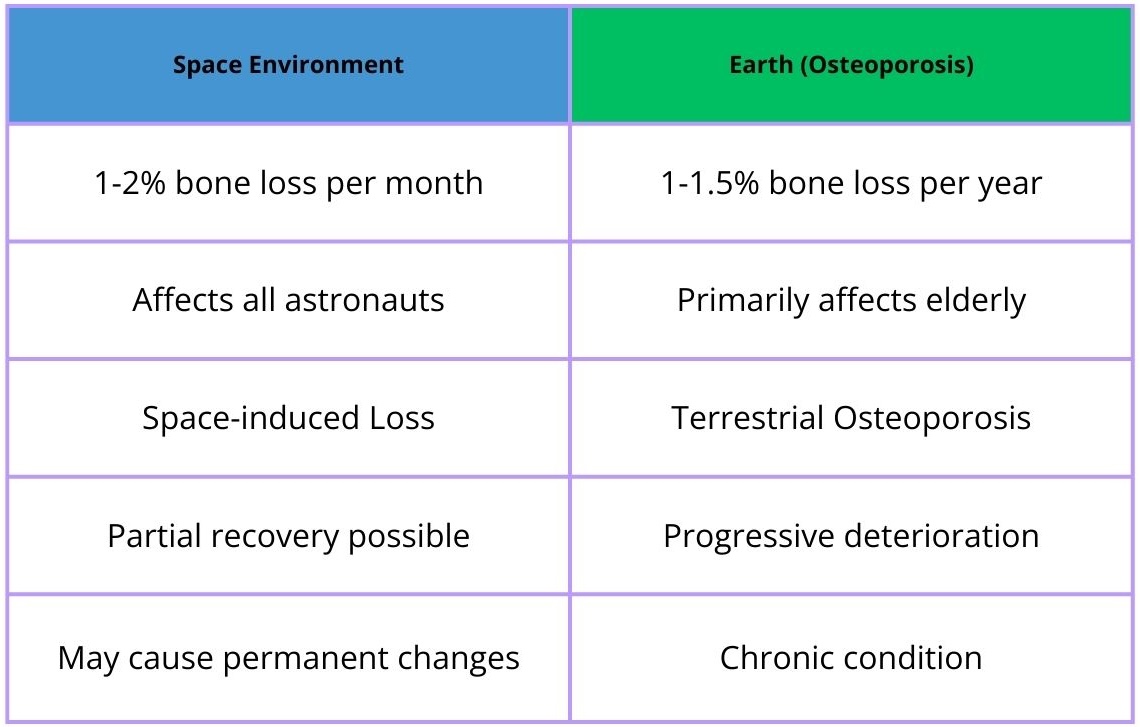
Space Environment Earth (Osteoporosis) 1-2% bone loss per month 1-1.5% bone loss per year
Affects all astronauts Primarily affects elderly
Space-induced Loss Terrestrial Osteoporosis Partial recovery possible Progressive deterioration May cause permanent changes Chronic condition

Impact of Space Travel on Astronauts
One of the most significant challenges astronauts face during space missions is the profound effect of microgravity on their bodies. In the absence of Earth’s gravitational pull, astronauts experience multiple physiological changes, including muscle atrophy, cardiovascular deconditioning, and most notably, severe bone loss. These changes can have lasting impacts on their health, particularly during long-duration missions.
Rate of Bone Loss in Space
Besides experiencing other physiological changes, astronauts face rapid bone deterioration at a rate of 1-2% per month during space missions. This rate is approximately 10 times faster than what occurs in severe cases of osteoporosis on Earth. The weight-bearing bones, such as the spine, hips, and legs, are particularly affected, with some astronauts losing up to 20% of their bone mass during six-month missions.
Recovery after Returning to Earth
Across various studies of returning astronauts, research shows that bone recovery is a slow and incomplete process. Even after a year back on Earth, many astronauts’ bones do not fully recover their original density, particularly in the hip region. For those who spent six months in space, only about 50% of their hip bone density returned after a year.
After examining 17 astronauts in a recent study published in Scientific Reports, researchers found that bone loss can become permanent, equivalent to a decade of aging. This discovery raises significant concerns about the feasibility of long-duration space missions, such as the planned Mars expeditions, which could last up to three years. The findings emphasise the need for more effective countermeasures to protect astronauts’ skeletal health during extended space travel.

Countermeasures Against Bone Loss
Unlike Earth-based treatments, space-related bone loss requires a comprehensive approach combining multiple strategies. NASA and other space agencies have developed advanced countermeasures that include specialized exercise equipment, nutritional supplements, and potential pharmaceutical interventions. These methods have shown promising results in reducing bone loss rates from 1-2% to 0.5-1% per month in astronauts during long-duration spaceflight.
Exercise Regimens
One of the most effective countermeasures is the Advanced Resistive Exercise Device (ARED), which allows astronauts to perform weight-bearing exercises in microgravity. The device simulates Earth-like resistance, requiring astronauts to complete a daily two-hour workout routine that includes squats, deadlifts, and other resistance exercises designed to maintain bone density and muscle mass.
Nutritional Interventions
Above standard dietary requirements, astronauts receive carefully calculated supplements of calcium (1000 mg) and vitamin D (800 IU) daily to support bone health. These supplements, combined with a protein-rich diet, help maintain bone mineral density during extended space missions.
It is worth noting that nutritional interventions extend beyond basic supplementation. Studies have shown that maintaining optimal protein intake and ensuring adequate caloric consumption are crucial factors in bone preservation. The space diet is specifically designed to provide nutrients that support bone remodeling, though the effectiveness varies among individuals based on their metabolic responses to microgravity.
Pharmaceutical Interventions
Many pharmaceutical approaches have been developed to combat bone loss in space travelers. These medications, combined with exercise protocols, have shown promising results in reducing the rate of bone density loss during space missions. Studies indicate that pharmaceutical interventions can help astronauts maintain up to 50% more bone mass compared to exercise alone during long-duration spaceflight.
Use of Bisphosphonates
To combat space-related bone loss, bisphosphonates have emerged as a primary pharmaceutical defense. These medications, commonly used to treat osteoporosis on Earth, work by inhibiting bone resorption. Research shows that astronauts taking bisphosphonates during missions experienced significantly less bone loss compared to those who relied solely on exercise protocols.
Emerging Treatments and Research
One of the most promising developments in space medicine involves targeted therapies that stimulate bone formation while inhibiting breakdown. Scientists have identified novel compounds that could potentially prevent up to 70% of space-related bone loss, offering hope for future long-duration missions to Mars and beyond.
In fact, recent studies have explored combinations of anabolic agents and antiresorptive medications, showing enhanced protective effects against microgravity-induced bone loss. These innovative approaches include peptide therapies, monoclonal antibodies, and gene-targeted treatments that could revolutionise space medicine. The research has also revealed potential applications for treating osteoporosis patients on Earth, demonstrating the broader benefits of space medical research.
Broader Implications for Health Care
Now, research on bone loss in space is revolutionizing our understanding of bone health on Earth. The accelerated bone deterioration in space serves as a unique laboratory for studying bone diseases, providing insights that would take decades to obtain through conventional research. This knowledge is particularly valuable for developing new treatments and preventive measures for various bone-related conditions affecting millions worldwide.
Insights into Osteoporosis
Before the advent of space research, scientists had limited opportunities to study rapid bone loss in real-time. Space-based studies have revealed that astronauts lose 1-2% of bone mass per month, offering an accelerated model for understanding osteoporosis progression. These findings have led to improved treatment strategies for osteoporosis patients, including more effective exercise protocols and medication timing.
Applications for Bedridden Patients
Beside space research applications, the findings have direct relevance for bedridden patients. The countermeasures developed for astronauts, including specialised resistance exercises and targeted nutritional supplements, are now being adapted to help prevent bone loss in long-term immobilised patients, showing promising results in maintaining bone density.
Another significant advancement comes from the development of bone density monitoring techniques originally designed for astronauts. These methods now enable healthcare providers to track bone loss more accurately in bedridden patients, allowing for earlier interventions and more personalised treatment plans. Studies show these approaches can reduce bone loss by up to 40% in immobilised patients.
Ethical Considerations of Space Exploration
To address the complex ethical dimensions of space exploration, scientists and policymakers must balance the advancement of human knowledge against the physical well-being of astronauts. The documented 1-2% monthly bone loss raises serious ethical questions about exposing humans to such significant health risks, especially for longer missions like the proposed Mars expeditions where astronauts could face permanent skeletal damage.
Health Risks vs. Scientific Benefits
Above all considerations stands the delicate balance between scientific progress and human safety. While space exploration has led to breakthrough discoveries and technological advancements, the severe health implications for astronauts, including potential irreversible bone density reduction, demand careful evaluation. Studies showing only 50% bone recovery in some astronauts after one year on Earth highlight the gravity of these concerns.
Potential Impact on Space Tourists
Between the growing interest in commercial space travel and the documented health risks, there emerges a significant concern for future space tourists. Unlike professional astronauts, these individuals may lack the rigorous physical preparation and medical monitoring systems, making them potentially more vulnerable to accelerated bone loss during their journeys.
Space tourism companies must develop comprehensive health screening protocols and preventive measures to protect their customers. The industry faces the challenge of implementing effective countermeasures such as specialised exercise equipment and medical interventions, while maintaining the commercial viability of their operations. The potential for legal and ethical implications regarding passenger safety adds another layer of complexity to this emerging market.
Final Words
Presently, the challenge of bone loss in space travel stands as a significant obstacle in humanity’s quest for long-term space exploration. The rapid deterioration of bone mass in microgravity environments, coupled with incomplete recovery upon return to Earth, demands innovative solutions from the scientific community. While exercise protocols and pharmaceutical interventions show promise, they have not fully resolved this pressing issue. As space agencies plan missions to Mars and beyond, they must continue developing comprehensive strategies to protect astronauts’ skeletal health, ensuring they can safely explore the cosmos and maintain their quality of life upon returning home.
FAQ
Q: How much bone mass can astronauts lose during space missions?
A: Astronauts can lose bone mass at a rate of 1-2% per month while in space, which is approximately 10 times faster than severe osteoporosis cases on Earth. During a 4-6 month mission on the International Space Station, some astronauts have lost up to 20% of their bone mass.
Q: Why does bone loss occur in space?
A: Bone loss occurs in space due to the lack of gravity’s constant pull on the body. In microgravity, bone-forming cells become less active while bone-resorbing cells continue their normal function. Without the regular stress signals that gravity provides on Earth, bones begin to weaken and lose density.
Q: How long does it take for astronauts to recover their bone density after returning to Earth?
A: Recovery of bone density is often incomplete, even after a year back on Earth. Research shows that astronauts who spent six months in space typically regained only about half of their hip bone density after one year. Some astronauts experience permanent bone loss equivalent to a decade of aging.
Q: What methods are currently used to prevent bone loss in space?
A: Space agencies employ several preventive measures including: two hours of daily exercise using specialized equipment like the Advanced Resistive Exercise Device, treadmills with bungee cords for resistance, calcium and vitamin D supplementation, and experimental use of osteoporosis medications like bisphosphonates.
Q: What are the implications of bone loss for future long-duration space missions?
A: The significant bone loss experienced during space travel poses major challenges for extended missions, such as a three-year journey to Mars. This health risk raises concerns about astronaut safety, recovery, and long-term health effects. Scientists are exploring solutions like artificial gravity and vibration plates to address these challenges for future space exploration.