The Science of Flu Superspreaders and Viral Loads
In every outbreak, a small group of people unknowingly spreads the most illness. Research shows that only 20% of infected individuals account for 80% of all infections. We’re looking at the biology behind these viral “engines” to help you understand your risk—and protect the people around you.
Key Takeaways:
- About 20% of infected people drive 80% of all respiratory illness outbreaks, and some individuals can carry up to 10 million times more virus in their respiratory fluids than others, with concentrations reaching a billion virus copies per millilitre at the high end. Your likelihood of being a superspreader depends heavily on where you are in your infection. People emit more particles dramatically when they’re at their sickest, with infected monkeys in one study going from breathing out 3,000-5,000 moisture particles per litre to 50,000-70,000 once sick. And it’s not just quantity either. The type of particles changes too, with sick people producing more tiny aerosol particles (less than five microns) that can travel deeper into someone else’s lungs and remain suspended in the air for much longer than larger droplets.
- The way you talk and breathe makes a huge difference in how many viral particles you spread around. Loud talkers produce up to 50 times more aerosols than quiet speakers, and if you really enunciate those hard consonants like T, K, and P, you’re probably spewing out more droplets with every word. Interestingly, certain vowel sounds in words like “need” and “sea” generate more particles than sounds in “saw” or “blue.” Your lung size matters too – people with larger lung capacity naturally breathe in and out more air, which means they’re shedding more virus. This can be genetic, but it’s also influenced by how active you were as a child. Childhood exercise leads to larger, stronger lungs in adulthood, whereas asthma or air pollution exposure can stunt development.
Even if you’ve got all the biological traits of a superspreader, you won’t actually spread much disease unless you’re in the right (or wrong) environment with the right behaviours. Superspreading happens way more often in poorly ventilated spaces where aerosols just hang around, and during activities like group exercise classes where people are breathing heavily – we produce 130 times more particles during hard exercise than at rest. The humidity level plays a sneaky role, too. In really dry environments, the fluid in breath particles evaporates quickly, making them smaller, more concentrated with the virus, and able to float around in the air for much longer periods before someone else breathes them in.
Some people have 10 million times more virus than others: Are you a flu superspreader?
The Real Deal About Who Actually Drives Most Flu Spread
That famous 80/20 rule? It applies to influenza transmission as well, and you might be surprised to learn that just 20% of infected people are responsible for 80% of all infections during an outbreak. Scientists have traced this pattern across everything from COVID-19 to measles, and the math is pretty consistent. What makes this even more startling is that viral load can vary by 10 million times between different infected people, with some folks carrying up to a billion virus copies per millilitre in their respiratory fluids. But here’s where it gets interesting – having high viral load doesn’t automatically make you a superspreader. Your biology, behaviour, and even the environments you hang out in all play a role in whether you’ll infect two people or twenty.
It’s not just luck – viral load and infection stage
When you’re at your absolute sickest, you’re basically a walking virus factory. Research on infected monkeys showed they went from exhaling 3,000-5,000 moisture particles per litre of breath to a staggering 50,000-70,000 particles once infected. And because each particle can carry 200-300 viral copies, the transmission potential skyrockets when you’re feeling your worst. But it’s not just quantity – sick people emit more small aerosol particles than larger droplets, and these tiny aerosols travel much deeper into the lungs of anyone unlucky enough to breathe them in. Scientists think viruses have evolved to exploit this, increasing replication to break down respiratory cells into smaller, more airborne fragments.
Body and biology – weight, lungs and mucus
Your physical characteristics might be setting you up as a superspreader without you even knowing it. Studies have found that overweight individuals tend to produce more respiratory droplets during breathing or coughing, likely because excess fat in the chest and abdomen prevents the lungs from fully expanding. This creates a shallower, faster breathing pattern that churns out more particles. Meanwhile, those with greater lung capacity naturally shed and transmit more virus simply because they’re moving larger volumes of air in and out with each breath.
Your mucus matters too, and everyone’s is different. Some people have mucus that’s basically a virus death trap – thick, sticky stuff that captures and inactivates pathogens before they can escape. Others? Their mucus is more like a slip-and-slide, allowing viruses to stay infectious and transmissible. The viscosity, texture, and even the microbiome living in your mucus all contribute to whether you’re keeping those viruses locked down or launching them into the air with every breath. Genetics determine some of this, but so does your childhood – doing more physical activity as a kid leads to larger, stronger lungs throughout adulthood, while childhood asthma or exposure to chronic air pollution can actively stunt lung development and change how you breathe for life.
Are you talking about people getting sick? How speech and singing crank up risk
Ever wondered if your chattiness could be making others ill? Turns out, the simple act of speaking launches thousands of microscopic particles into the air around you – and loud talkers generate up to 50 times more aerosols than quiet speakers. Researchers studying speech patterns across English, Spanish, Mandarin, and Arabic found that your vocal cords open and close more frequently when you’re loud, creating more opportunities for virus-laden particles to form at the voicebox. And if you’re a singer or someone who loves belting out tunes? You’re producing even more. Some people have 10 million times more #virus than others, and how you use your voice might be amplifying your spread without you even knowing it.
Loud talkers and singers – why volume matters
Your volume dial isn’t just annoying your coworkers… It may be showering them with infectious particles. The California study measuring breath particles found something pretty wild: speaking loudly doesn’t just increase particle output by a little bit – it multiplies it by 50. Because your vocal cords are working overtime when you’re projecting your voice, each vibration creates another opportunity for moisture droplets to form and carry virus particles out into the world. Singers, choir members, and that one colleague who never learned their inside voice? They’re all producing significantly more aerosols than someone speaking at normal conversational levels.
Those T, K and P sounds – weirdly important
Here’s something bizarre you probably never thought about: the specific letters you’re pronouncing could determine how many viral particles you’re spewing. Consonants like T, K, and P – called plosives – force you to emit more droplets because they require a sudden burst of air from your mouth. The 2020 study on vocalisation patterns showed that these sounds produce smaller bursts of breath particles than softer consonants. So if you’re someone who enunciates sharply and clearly, you might actually be a more effective spreader than someone who mumbles their words.
But it gets even weirder with vowel sounds. Words containing “ee” sounds like “need” and “sea” produced significantly more breath particles than words with “aw” sounds like “saw” or “oo” sounds like “mood” and “blue”. Scientists think this has to do with the shape your mouth makes and how air flows past your tongue and teeth during different vowel formations. The tighter, more forward tongue position required for “ee” sounds appears to produce greater turbulence and particle generation. So technically, your accent and speech patterns – things you’ve probably never connected to disease transmission – could be influencing how infectious you are when you’re sick.
My take on lungs, breath and why kids usually aren’t the culprits
Your child’s smaller lungs might actually be protecting their classmates more than you’d think. Pre-adolescent children simply don’t move the same volumes of air that adults do – their lung size, airway dimensions, and number of air sacs are all significantly smaller. This means even when they’re infected, they’re exhaling fewer viral particles with each breath compared to grown-ups. While children can certainly spread illness, the physics of their respiratory system works against their becoming superspreaders in the same way adults can. Assume that a child’s smaller respiratory capacity naturally limits their ability to disperse high concentrations of virus into shared spaces.
Lung size, breathing depth and exercise
What you did as a kid might determine how much virus you’re breathing out right now. Physical activity during childhood can lead to larger, stronger lungs throughout your entire adult life, while childhood asthma or chronic exposure to air pollution can permanently stunt lung development. And here’s the kicker – people with greater lung capacity who breathe deeper volumes of air are more likely to shed and transmit more virus, according to Bischoff. So if you were an active kid running around outdoors, you might ironically have developed the exact lung capacity that makes you a more efficient disease spreader. Assume that your current lung capacity, shaped by your childhood experiences, plays a significant role in your superspreading potential.
- Lung capacity varies considerably, even among healthy adults
- Childhood physical activity builds larger, stronger lungs for life
- Childhood asthma or pollution exposure can stunt development
- Greater lung volume means more viral particles are exhaled per breath
Mucus, microbiome and other secret factors
The jelly-like coating inside your nose and lungs has its own personality – and it might be secretly protecting everyone around you. Respiratory mucus characteristics vary wildly from person to person, with different viscosities, textures, and unique microbiome recipes. Some people’s mucus acts like a highly effective viral trap, inactivating pathogens before they can become airborne, while others have mucus that basically lets viruses spread freely and remain infectious. Scientists are still unravelling how these individual mucus properties influence transmission, but early research suggests your personal mucus makeup could be just as important as how loudly you talk. Assume that the invisible characteristics of your respiratory mucus are quietly determining whether you’re a viral broadcasting station or a natural containment system.
- Mucus viscosity and texture differ dramatically between individuals
- Mucus microbiome composition is unique to each person
- Viral trapping efficiency varies based on mucus properties
- Some mucus types inactivate viruses more effectively than others
Scientists are discovering that your respiratory mucus isn’t just a passive barrier – it’s an active player in whether you become a superspreader. The specific proteins and antimicrobial compounds in your mucus can either neutralise viral particles or allow them to remain viable and transmissible. Your mucus microbiome, that complex ecosystem of bacteria living in your respiratory tract, also influences how viruses behave once they’re in your system. Research suggests that individuals with specific microbiome compositions may naturally suppress viral replication or alter how particles are released into the air. Even factors like hydration levels affect your mucus consistency – when you’re dehydrated, your mucus becomes thicker and stickier, potentially trapping more particles. But the flip side is that thicker mucus might also concentrate viruses in ways that make them more infectious when they do escape. Assume that your body’s mucus production and microbiome represent a hidden variable in the superspreading equation that researchers are only beginning to understand.
Where the spread happens – the places that make you a superspreader
You might have all the biological markers of a superspreader, but where you spend your time matters just as much as what’s happening inside your body. The environment you’re in can either amplify or dampen your ability to spread infection, and certain spaces are practically designed to turn even average shedders into transmission machines. Your local spin class or that packed bar you love? They’re not just social hotspots, they’re viral highways waiting for the right person to walk through the door.
Gyms, bars and closed rooms – the usual suspects
Group exercise classes rank among the most superspreading environments, and it’s not hard to see why. When you’re huffing and puffing through burpees in a windowless studio, you’re producing more than 130 times more aerosols than when you’re sitting on your couch. Add in a dozen other people doing the same thing, poor ventilation, and you’ve got yourself a perfect storm. Bars aren’t much better – you’re talking loudly over music, spending hours in the same enclosed space, and let’s be honest, probably getting closer to strangers than you normally would.
Humidity, ventilation and the sneaky physics
The physics of how particles behave in different environments is where things get really interesting. In very dry settings, the fluid within your breath particles evaporates quickly, making them smaller, more concentrated with the virus, and able to stay airborne much longer. It’s like your respiratory droplets are getting weaponisedby the air itself. Proper ventilation can sweep these particles away before anyone else breathes them in, but in poorly ventilated spaces, they just… hang there, waiting. Temperature and humidity work together in ways that can either protect or endanger everyone around you. Studies show that in spaces with low humidity – think heated indoor environments during winter – viral particles become more stable and infectious. The moisture coating on aerosols shrinks, concentrating the virus and allowing particles to float longer distances. Meanwhile, good ventilation systems can reduce airborne viral concentrations by 70% or more, but most buildings simply weren’t designed with pandemic-level air exchange in mind. So that conference room where you’re stuck for three hours? The air you’re breathing might have cycled through your colleagues’ lungs multiple times already.

How to tell if you’re the kinda person who could superspread
Scientists have pinpointed several telltale markers that suggest you might be carrying 10 million times more virus than the average infected person. Your risk profile starts with basic biology – if you’re male, over 40, or carrying extra weight, you’re already checking boxes on the superspreader checklist. But it goes deeper than that. Research showing some people have vastly higher viral loads reveals that your lung capacity, mucus composition, and even how you pronounce certain letters all factor into whether you’re silently spreading illness everywhere you go. The scary part? You might tick every box and never know it until you’ve already infected a dozen people.
Quick signs and risk checkpoints
Your voice volume matters more than you’d think – loud talkers generate up to 50 times more aerosols than quiet speakers. If you’re someone who enunciates hard consonants like T, K, and P with force, you’re launching more viral particles with every word. People who had active childhoods typically have larger lung capacity, meaning they’re now exhaling greater volumes of potentially infectious air. And if you’re the type who gets really sick when illness hits – fever, heavy symptoms, the whole nine yards – you’re producing up to 70,000 moisture particles per litre of breath compared to the usual 3,000-5,000.
Habits that push your risk way up
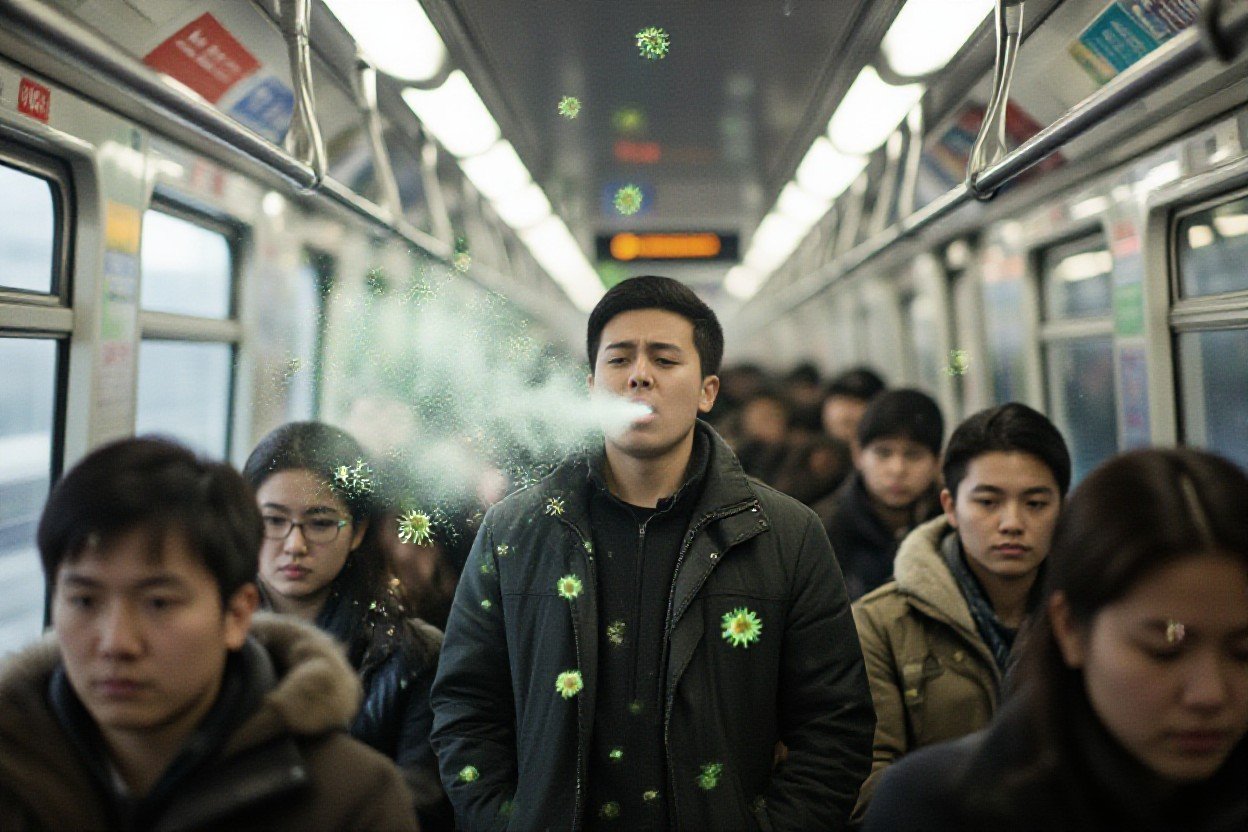
Spending time in poorly ventilated spaces basically turns you into a walking infection factory. Group exercise classes are superspreader hotspots because you’re breathing heavily in enclosed spaces, pumping out 130 times more aerosols than when you’re at rest. Singing, shouting, or even just being an enthusiastic close-talker dramatically increases your particle output. If you’re constantly in crowded indoor environments with low humidity – think offices with dry heating systems or air-conditioned gyms – those conditions make your breath particles smaller, more concentrated with the virus, and capable of staying airborne way longer.
The environmental piece is honestly just as important as your biology. You could have perfect mucus composition and small lungs, but if you’re teaching indoor spin classes three times a week or leading choir practice in a basement with zero airflow, you’re setting yourself up to spread illness regardless of your natural traits. Social behaviour compounds everything – the person with average viral shedding who spends hours daily in close contact with others in stuffy rooms will likely infect more people than someone with high viral loads who works from home alone. It’s the combination that gets you… Your physiology sets your potential, but your habits and environment determine whether that potential gets realised.What you can actually do about it – practical steps that work
Knowing you might be breathing out 50,000 to 70,000 particles per litre of breath when you’re sick changes everything, doesn’t it? The good news is that you don’t need fancy equipment or expensive interventions to dramatically cut your risk of spreading illness. Simple adjustments to your environment and behaviour can reduce transmission by huge margins – we’re talking about blocking those aerosols that stay suspended in dry air for hours, and stopping droplets before they travel into someone else’s lungs. And honestly, most of these changes are so small you’ll barely notice them after a week or two.
Masks, ventilation and small behaviour changes I recommend
Cracking open a window reduces airborne viral particles by up to 70% in indoor spaces, which is pretty remarkable for such a simple action. If you’re in a room with others, increasing humidity to 40-60% makes those tiny aerosol particles less concentrated with the
virus and helps them drop out of the air faster instead of floating around. Wearing a well-fitted mask when you’re feeling under the weather blocks the majority of those breath particles before they even escape – especially important if you’re a loud talker or someone who tends to enunciate harshly. And here’s something you can do right now: lower your voice during conversations when you’re sick, because loud speech generates up to 50 times more aerosols than quiet talking. If you’re sick – the don’ts and dos to stop spreading
Don’t go to that gym class or singing group when you’re at your sickest – you’re producing 130 times more aerosols during heavy breathing than at rest, and those particles carry 200 to 300 viral copies each. Don’t be the close talker who leans in while chatting, especially in poorly ventilated spaces where your breath particles will linger for ages. Do stay home during your peak symptoms when you’re shedding the most virus… and if you absolutely must go out, do keep your distance and speak softly.
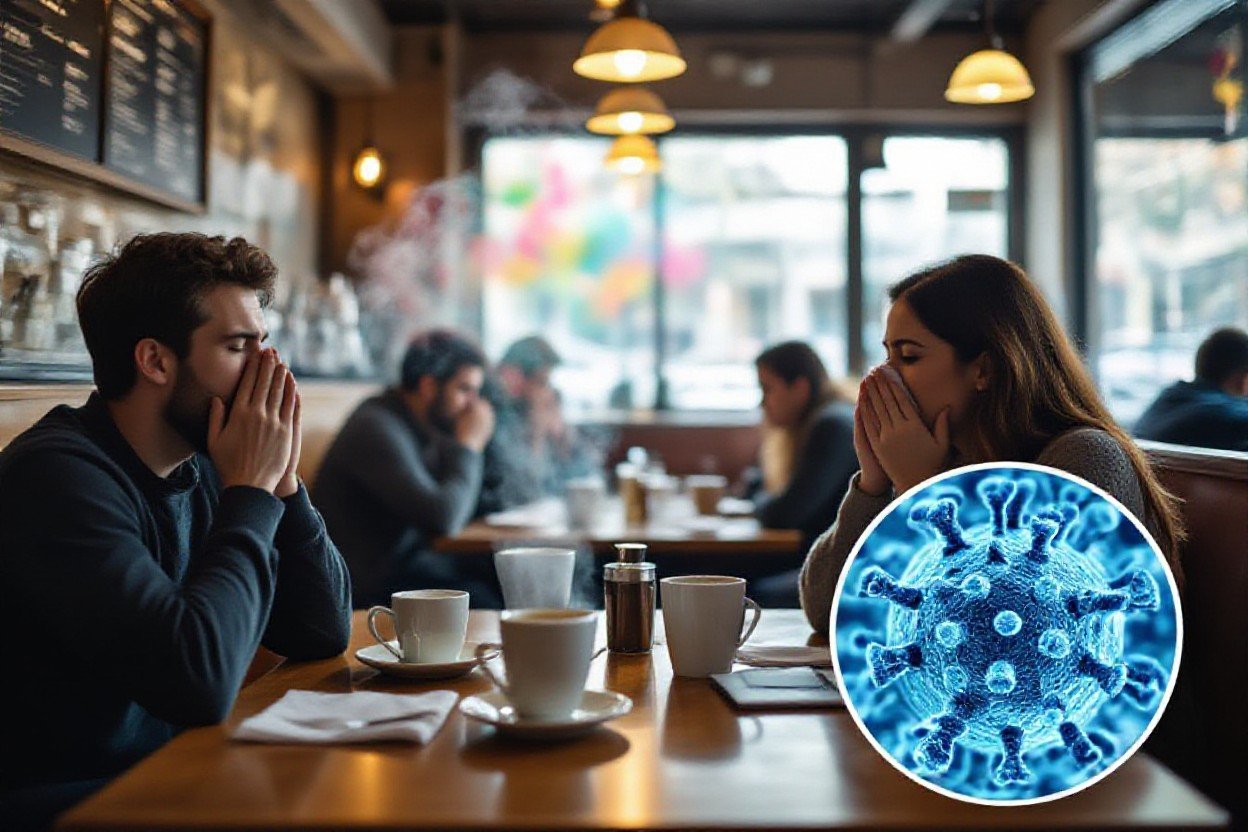
The stage of your infection matters more than almost anything else when it comes to spreading illness. When you’re at your sickest – fever, body aches, that overwhelming fatigue – you’re not just feeling terrible, you’re also breathing out 10 to 14 times more particles than when you’re healthy. Those first few days of peak symptoms are when you’re most dangerous to others, so this is when staying isolated actually makes the biggest difference. If you’ve got a billion virus copies per millilitre in your respiratory fluids (which some people do), every cough or even normal breath becomes a potential transmission event. So yeah, those sick days aren’t just for your recovery – they’re protecting everyone around you from becoming infected too.
Conclusion
Now you know that superspreading isn’t just about bad luck – it’s actually a complex mix of biology, behaviour, and environment working together. Your lung capacity, how loudly you talk, even the viscosity of your mucus… all these factors can influence whether you’re more likely to spread the flu to others. And here’s the thing – you might have all the physical traits of a superspreader, but never actually become one if you’re careful about ventilation and limiting close contacts when you’re sick. So next time you feel that scratchy throat coming on, think about those 10 million viral particles potentially multiplying in your system and maybe skip that crowded gym class or karaoke night.
Can I actually test myself to see if I’m a superspreader, or is this something I’d only find out after accidentally infecting a bunch of people?
Here’s the thing about superspreading – it’s not really something you can just walk into a doctor’s office and get tested for. There’s no “superspreader gene” test or anything like that. The reality is way more complicated because it depends on so many different factors coming together at once. When you’re at your sickest with the flu, that’s when you’re producing the most viral particles with every breath… we’re talking potentially 10 million times more virus than someone else with the same infection. But whether you actually become a superspreader also depends on your behaviour during that time. Are you the type who pushes through illness and goes to work anyway? Do you attend a spin class while feeling under the weather? Those choices matter just as much as your biology. Some research labs can measure how many respiratory particles you produce when you talk or breathe, but that’s mostly done in experimental settings. And honestly, even if you found out you produce more aerosols than average, what would you do with that information? The best approach is just to assume that when you’re sick, you could potentially spread it to others more easily – especially if you’re a loud talker, overweight, or have a larger lung capacity. Stay home when you’re ill, wear a mask if you must go out, and avoid crowded indoor spaces during peak symptoms.
If kids produce fewer respiratory particles because of their smaller lungs, why do they always seem to bring home every single bug from school?
Yeah, this seems like a total contradiction, right? Kids have smaller lungs and breathe out less air, so theoretically they should be spreading fewer viruses. But anyone with children knows they’re basically walking germ factories. The answer is that superspreading isn’t just about particle production. Kids might not be individual superspreaders in the technical sense, but they make up for it in other ways. They’re constantly in close contact with each other – sharing toys, touching everything, not covering their coughs properly (or at all). They’re also spending hours together in enclosed classroom spaces with sometimes questionable ventilation. And let’s be real, kids aren’t exactly known for their hygiene habits. Plus, children’s immune systems are still developing, which means they catch more infections in the first place. So while each individual kid might not be producing as many viral particles as an adult superspreader, you’ve got a whole classroom of them getting sick one after another, passing bugs back and forth like trading cards. It’s the cumulative effect that gets you. One adult superspreader at a conference might infect a dozen people… but a classroom of 25 kids? That’s a different kind of outbreak scenario entirely, even if no single child qualifies as a superspreader by the scientific definition.
Does this mean I should avoid loud talkers and people who say words with lots of T’s and K’s when flu season hits?
I mean, you could try, but good luck explaining that one at your next dinner party. “Sorry, can’t sit near you – you enunciate too clearly, and I’m worried about your consonants.” But seriously, the research on certain sounds producing more droplets is fascinating… and also somewhat impractical for everyday life. Yes, harsh consonants such as T, K, and P produce more respiratory particles. And yes, loud talkers produce up to 50 times more aerosols than quiet speakers. But you can’t exactly go around asking people to mumble and whisper for three months every winter. What you can do is be more aware of your environment during flu season. If someone’s talking loudly in a small, poorly ventilated room, maybe crack a window or suggest moving the conversation elsewhere. If you’re stuck in a meeting with someone who’s projecting their voice like they’re on stage while also clearly fighting off a cold… well, that’s when masks become your friend. The bigger takeaway here is understanding that transmission isn’t just about whether someone’s sick – it’s about how they’re sick, how they communicate, and where you’re interacting with them. A quiet person with the flu sitting six feet away outdoors? Probably low risk. A loud, enthusiastic speaker who loves words like “keep talking” and “spectacular” while sick in a stuffy conference