Introduction: The 10-Minute Walk That Changes Everything
Estimated reading time: 12 minutes
Key Takeaways
- Light activity (easy walks, chores) lowers major cardiac events by ~20% and all-cause mortality by ~22% in new type 2 diabetes.
- Moderate-to-vigorous activity (brisk walking, swimming) lowers risk by ~30%–31%.
- Benefits appear quickly after diagnosis and persist after adjusting for blood pressure, LDL, HbA1c, and kidney function [2].
- Women and those over ~62 years experience even stronger protection [2].
- Pair aerobic and resistance training—and if weight loss is a goal, even 5%–10% loss multiplies benefits [3][4].
Table of Contents
1. Introduction
Picture this. It’s late afternoon. You’ve just finished a telehealth appointment where you heard the words “type 2 diabetes” for the first time. The screen goes dark. Your mind spins. What now? Medications? Diet? Blood tests? It’s a lot.
Now imagine your doctor asks one simple question before you log off: “How much do you move in a typical day?” Not a fitness interrogation. Just a snapshot. Because here’s the surprising truth: the answer to that single question can help predict your future heart health and even your odds of living longer—especially in the first couple of years after your diagnosis.
If you have type 2 diabetes, your heart is front and center. Cardiovascular disease is the storm cloud that often hangs over the diagnosis—heart attacks, strokes, heart failure. But there’s a bright patch of sky you can walk toward—literally.
A large real-world study followed 11,355 people newly diagnosed with type 2 diabetes and no prior heart disease. Compared with mostly sedentary participants, those doing light physical activity had a 20% lower risk of major cardiac events and a 22% lower risk of dying from any cause. Moderate-to-vigorous activity yielded even larger drops: 30% and 31%, respectively [2].
And here’s the clincher: these protective effects appeared immediately after diagnosis and remained strong even when accounting for blood pressure, cholesterol, HbA1c, and kidney function [2]. Women and those over about 62 saw the biggest gains [2].
This article guides you through why movement matters, how it rewires metabolism, and how to build a practical plan—no marathon training required.
2. Core Concepts & Mechanisms: How Movement Rewires Your Metabolism and Protects Your Heart
The metabolic handshake: muscles and glucose
Muscles are like engines. Even gentle movement pulls GLUT4 transporters to the cell surface, letting glucose in without extra insulin. Over time, insulin sensitivity improves, easing pancreatic strain and stabilizing blood sugar spikes.
Endothelial tune-up
Movement increases blood flow, shearing vessel walls and boosting nitric oxide release. The result: better vasodilation, lower blood pressure, and stronger arteries.
Less inflammatory “fire,” fewer clots
Exercise lowers inflammatory markers and reduces platelet stickiness—translating to fewer plaque ruptures and clots.
Visceral fat reduction
Physical activity shrinks harmful visceral fat and improves fat’s metabolic profile—even without large scale changes.
Independent effects on BP and lipids
Yes, exercise lowers blood pressure and boosts HDL. But even after adjusting for these, activity independently cuts cardiovascular risk [2].
Mitochondrial magic
Activity builds and sharpens mitochondria—your cellular power plants—leading to smoother energy production and less oxidative stress.
Smoothing glycemic variability
Every post-meal walk acts like a traffic crew clearing glucose surges in real time, protecting arterial lining.
Autonomic balance
Regular movement boosts parasympathetic tone, improving heart rate variability and lowering arrhythmia risk.
Intensity defined
- Light: Talking easily—slow walks, casual cycling, light chores.
- Moderate: Talking, not singing—brisk walking, dancing, water aerobics.
- Vigorous: Short phrases only—running, fast cycling, high-intensity circuits.
Guideline targets (~7.5–20 MET-hours/week) cut events across genetic risk groups [1]. Extreme volumes (>80 MET-hours/week) may backfire in high-risk genetics [1].
Window of opportunity
In the first two years post-diagnosis, even light activity drives a “wet concrete” effect—shaping vascular set points toward protection [2].
Strength training
Resistance work preserves muscle mass—a glucose sponge. Two or three sessions weekly with simple body-weight or band moves amplify benefits [4].
Weight loss synergy
Modest weight loss (5%–10%) combined with activity yields the lowest cardiovascular event rates, per Look AHEAD analyses [3]. But movement alone remains protective [2].

3. Clinical Evidence & Real-World Impact
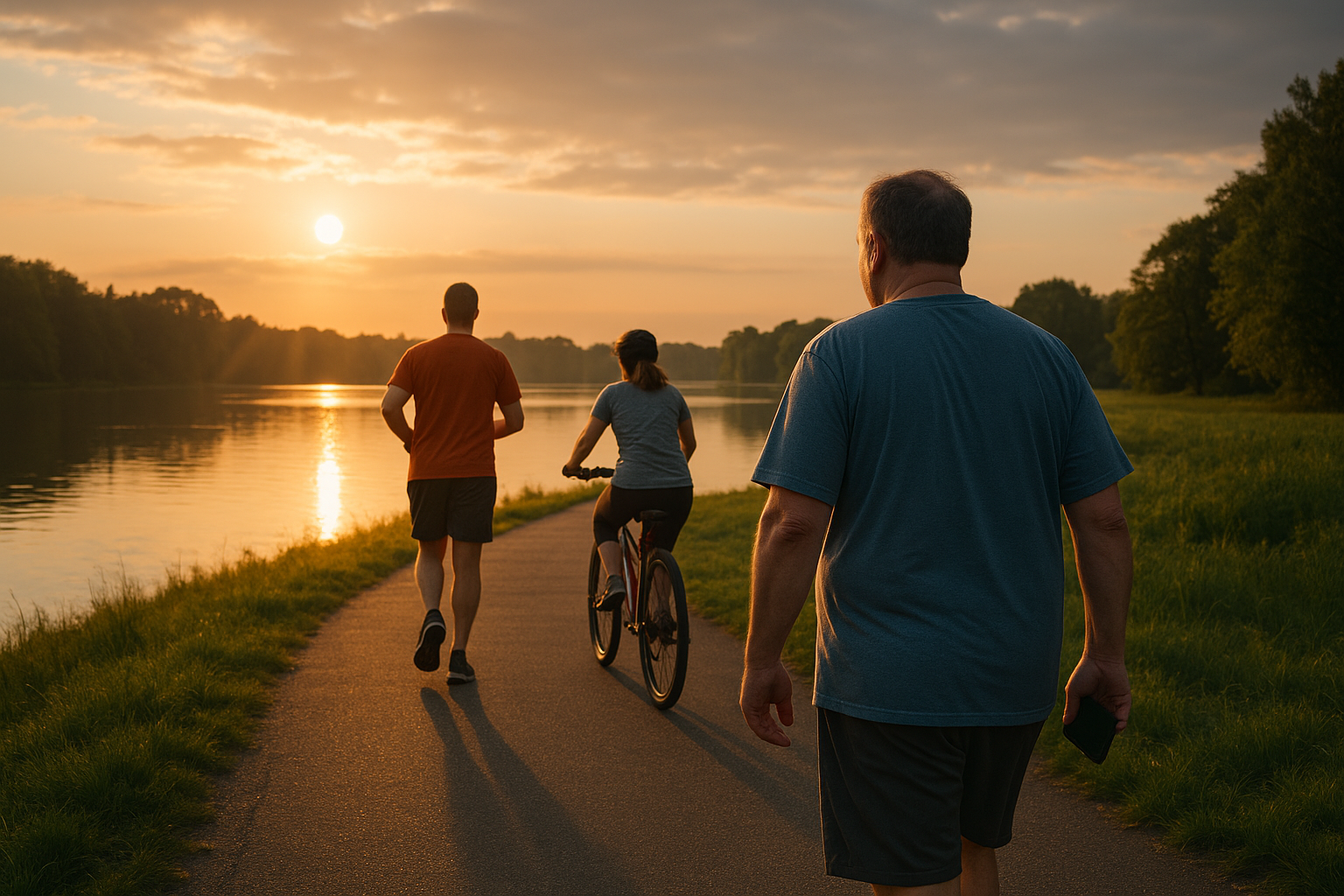
A Danish cohort of 11,355 adults
Newly diagnosed type 2 diabetes patients reported activity levels. Over follow-up, light activity linked to 20% fewer major events and 22% lower mortality; moderate-to-vigorous activity to ~30%–31% reductions [2]. Effects stronger in women and those >61.7 years [2].
The power of one question
Clinicians can ask: “How many days per week do you get ≥30 minutes of activity that quickens your breath?” A “rarely” answer flags high risk and prompts immediate counseling [2].
Stories in motion
- Anna, 64: Switched from sedentary to daily 10-minute walks and two weekly band sessions—noticed stamina gains and invisible vascular benefits.
- Marco, 52: Added 10-minute brisk lunch walks and hourly 2-minute activity snacks—ideal for his forklift-operator schedule.
- Priya, 39: High genetic risk but balanced spin classes with walks and yoga—staying in the “just-right” zone [1].
- Nora, 58: Combined 15–20 minutes brisk walking five days/week with 6% weight loss—achieved the lowest observed event rates [3].
Rapid benefits
Protective effects begin within weeks post-diagnosis [2]. No need to wait for “perfection.”
Aerobic + resistance
Guidelines: ≥150 min/week moderate aerobic plus ≥2 days/week strength work [4]. The combo is a one-two punch for heart and metabolism.
Breaking the all-or-nothing trap
Even light activity is firmly on the right side of the ledger [2]. Protect your streak with movement snacks on tough days.
4. Treatment & Management Approaches
Use a simple framework and tailor to your life, medications, and goals.
Step 1: Baseline snapshot
- Ask: “On how many days this week did I get ≥30 minutes of activity that quickens my breath?”
- Note total sitting hours and breaks.
- Identify approachable activities (walking, cycling, water aerobics, dancing).
Step 2: Minimum effective dose
- Sedentary: Start with 10-minute walks once or twice daily (light activity already cuts risk [2]).
- Occasional: Build to 150 min/week moderate aerobic in any chunks.
- Add ≥2 strength sessions: 8–12 reps per move, 2–3 sets.
Step 3: Choose your tools
- Aerobic: Brisk walking, cycling, swimming, dancing.
- Resistance: Chair sit-to-stand, wall push-ups, band rows.
- Mobility & balance: Tai chi, yoga, single-leg stands.
Step 4: Safety & comorbidities
- Neuropathy: Inspect feet, choose low-impact (cycling, water aerobics).
- Retinopathy: Avoid heavy straining/inversion.
- Cardiac symptoms: Stop for chest pain, severe dyspnea, lightheadedness.
Step 5: Medication & hypoglycemia
- Metformin, GLP-1RA, SGLT2i: low hypo risk.
- Insulin/sulfonylureas: check glucose pre/post, carry carbs, time exercise post-meal.
Step 6: Interrupt sitting
Every 30 min sitting → 2–5 min stand/move. These “activity snacks” add up [2].
Step 7: Sample weekly plan
- Mon: 15′ post-dinner walk + 10′ body-weight strength
- Tue: Two 10′ walks + light stretching
- Wed: 25′ brisk cycling + balance drills
- Thu: 10′ morning walk + 15′ strength session
- Fri: 20′ interval walk + mobility
- Sat: Active recreation (gardening, dancing)
- Sun: Restorative stroll & stretching
Step 8: Gentle progression
Increase time/intensity ≤10% weekly. Use the talk test and rate-of-perceived exertion (~4–6 of 10).
Step 9: Measure what matters
- Steps: Aim for 6,000–8,000/day, add 500 steps/day increments.
- Streaks: Log “movement moments.”
- Quality of life: Track energy, sleep improvements.
Step 10: Weight loss layer
5%–10% weight loss enhances benefits, per Look AHEAD [3]. But remember: exercise is protective even without weight change [2]. For nutrition guidance, see Comprehensive Healthy Eating Tips for a Vibrant Lifestyle.
Special populations
- Older adults (≥61.7 yrs): High return on movement—focus on balance and strength [2].
- Women: Extra protection per minute of activity [2].
- Joint pain: Cycling, water aerobics, progressive strength training.
- High genetic risk: Moderate volumes; avoid excessive intensity [1].
HIIT?
Optional. Short 30″/90″ intervals can boost insulin sensitivity but aren’t required for protection.
Medication synergy
Movement multiplies benefits of metformin, SGLT2i, and GLP-1RA. It independently reduces risk [2].
5. Prevention & Practical Applications
Knowledge alone won’t move you. Build habits that stick.
Find your “why”
- “I want energy after work.”
- “I want to keep up with grandkids.”
Write it where you see your shoes.
Shrink friction
Lay out shoes, keep bands by TV. Zero setup = fewer excuses.
Embed movement
- Phone calls → pacing.
- Coffee brew → calf raises.
- Park farther; take stairs.
The 2-minute rule
On low-motivation days, commit to 2 minutes. Momentum often carries you further.
Activity anchors
- After breakfast: 10′ walk.
- After dinner: 10′ walk/stretch.
- Every 30 min sitting: 2′ move.
Social or solo
Walking buddies or podcasts—choose what motivates you.
Track kindly
Simple log of walks, strength, breaks. Focus on consistency over perfection.
Plan for setbacks
- Travel kit: band + body-weight plan.
- Bad weather: indoor loops, YouTube routines.
- Fatigue: light mobility—something beats nothing [2].
Sleep & stress
Movement improves sleep; good sleep fuels activity. Walking doubles as stress therapy. Try breath-step sync: inhale 3 steps, exhale 4.
Food synergy
- Pre-exercise snacks if needed.
- Post-meal 10′ walk flattens spikes.
- Hydrate—fatigue signals mimic dehydration.
Safety recap
- Start low, go slow. Warm up/cool down.
- Stop for chest pain, severe dyspnea, dizziness, palpitations.
- Insulin users: check glucose and carry fast carbs.
- Neuropathy: protect feet, choose low-impact.
Monthly self-assessment
- 10′ brisk walk without stopping?
- 10 sit-to-stands without hands?
- 10-sec single-leg balance?
“No” answers = next training targets.
This aligns with The Critical Importance of Preventive Healthcare: How Proactive Health Measures Save Lives and Transform Communities and The Importance of Preventive Healthcare: A Comprehensive Guide to Evidence-Based Prevention Strategies.
6. Conclusion & Future Outlook
Movement is your plotted course to better heart health in type 2 diabetes. You don’t need heroics—just ordinary minutes, done often.
- Light activity → 20% fewer events, 22% lower mortality [2].
- Moderate-vigorous → ~30% reductions [2].
- Quick onset, independent of BP, LDL, HbA1c, kidney function [2].
- Stronger effects in women and ≥62 years [2].
- Moderate volumes protect across genetics; extremes may harm high-risk [1].
- Aerobic + resistance + modest weight loss = maximum benefit [3][4].
Future care may use wearables and personalized prescriptions—yet your next walk is powerful today. Lace up, step outside for ten minutes, and let your heart thank you.
FAQ
- What counts as light physical activity?
- Any movement you can do while talking easily: slow walking, casual cycling, household chores, tai chi.
- How soon will I see benefits?
- Studies show protective effects within weeks of starting light activity [2]. You may notice better energy and sleep quickly.
- What if I have joint pain?
- Choose low-impact options—cycling, water aerobics, elliptical—and add gentle strength work to support joints.
- Can diet alone reduce my risk?
- Nutrition is vital. For comprehensive guidance, see Comprehensive Healthy Eating Tips for a Vibrant Lifestyle. But exercise independently lowers cardiovascular risk [2].
- How do I balance medications and exercise?
- Metformin, SGLT2i, GLP-1RA rarely cause hypoglycemia. If on insulin/sulfonylureas, check glucose pre/post activity and carry fast carbs. Adjust timing around meals.
“`